
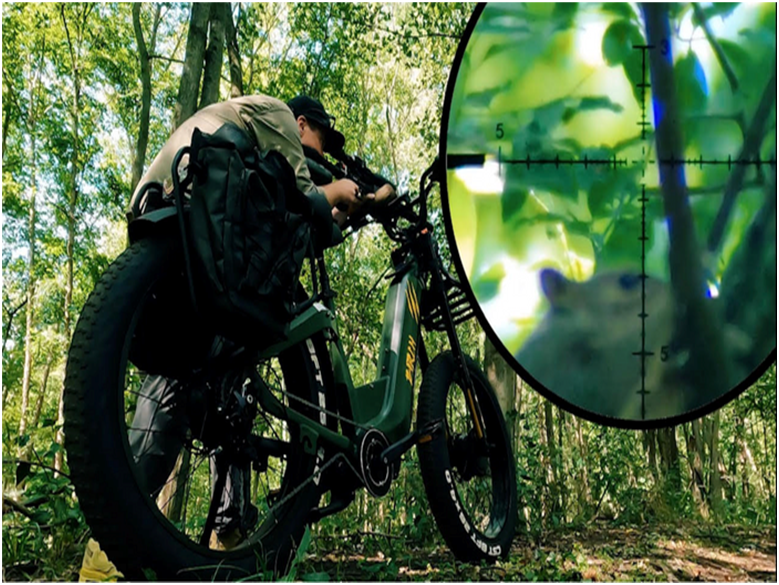
The conversation around e-bike power limits can get incredibly academic, but the moment you point a 1000-watt electric bike at a steep, gravel-strewn ridge, the textbook definitions don’t matter anymore.
For years, the e-bike world was dominated by 250W and 500W motors. They are great for flat city streets, but if you weigh over 200 pounds, haul heavy outdoor gear, or live in a place where the hills look like walls, those smaller motors will lag, overheat, and leave your knees doing the heavy lifting.
Stepping up to a true 1000W platform changes the game entirely. It shifts the machine from a “bicycle with assistance” into a high-torque utility vehicle. After spending a few hundred miles on both 1000W mid-drives and dual-motor setups, here is the honest truth about what that power feels like, where it shines, and the legal realities nobody tells you about.
1. Raw Torque vs. Top Speed: The Real Benefit of 1000W
The biggest misconception about 1000W e-bikes is that they are built just to go dangerously fast. While most 1000W motors can easily push a bike past 30 mph if unlocked, that isn’t the real reason to buy one.
The real benefit is low-end grunt.
[500W Motor] —> Struggles under load —> Heats up, bogs down on steep inclines.
[1000W Motor] —> High-torque reserve —> Maintains momentum through mud, sand, and ridges.
When you are climbing a loose, rocky switchback or trying to plow through six inches of wet snow, a 500W motor can bog down and stall. A 1000W motor provides a massive power reserve. It gives you the sustained torque—often ranging from 95Nm to a staggering 160Nm—to maintain your momentum without straining the motor or melting your controller electronics.
What surprised me the most was how effortless it makes hauling gear. If you hook a cargo trailer loaded with 100 pounds of firewood, camping gear, or fresh game to a 1000W mid-drive, the bike doesn’t stutter. You downshift, apply pedal assist, and the bike just climbs.
2. Mid-Drive vs. Hub-Drive: Where Should the 1000W Go?
Not all 1000W setups distribute their power the same way. You have to choose how that power hits the ground:
The 1000W Mid-Drive (The Mountain Tractor)
Motors like the Bafang Ultra M620 place the 1000W of power directly in the middle of the frame, running it through your chain and rear cassette.
- The Advantage: By leveraging the bike’s actual mechanical gears, a mid-drive multiplies its torque. It is the ultimate system for vertical climbs, technical single-tracks, and backcountry hunting.
- The Real-World Check: 1000W of electric force combined with human leg power puts immense stress on your chain. If you shift gears carelessly under full load, you will snap a chain in the deep woods.
The 1000W Hub-Drive (or Dual 500W Setup)
This places the power directly inside the wheel hub (or splits it into two 500W motors for All-Wheel Drive, like the Birch Grolar).
- The Advantage: Power completely bypasses your chain and derailleur. If your chain snaps three miles from camp, a hub motor can still throttle you home. It offers incredible traction in loose sand, mud, and flat marshlands.
- The Real-World Check: Hub motors can struggle with heat dissipation on long, near-vertical alpine climbs because they can’t leverage the bike’s gears.
3. The Elephant in the Room: Legalities and Land Access
Here is where things get complicated. If you are riding on private land, a private lease, or off-road vehicle parks, you can run whatever wattage you want. But on public property, the rules are rigid.
Under the standard three-tier e-bike classification system used across most of the United States, the legal limit for a street-legal e-bike is 750W (1 horsepower).
[Class 1 & 2] —> Max 750W —> Street Legal / Bike Lanes
[Class 3] —> Max 750W —> Street Legal / Commuter Lanes
[1000W Base] —> Over Limit —> Strictly “Off-Road Use Only” on public infrastructure
Because a 1000W motor technically exceeds this limit, many manufacturers utilize a smart workaround: Programmable Firmware.
Out of the box, the bike’s display limits the motor output to 750W, keeping it legally classified as a Class 1 or Class 3 bike for public paths and U.S. Forest Service roads. However, when you cross onto private land or designated off-road trails, a quick dive into the display settings allows you to unlock the full 1000W+ “Unlimited Mode.”
4. The Trade-Offs: Range and Weight
I promised to include the imperfections, so here is the thing nobody tells you: 1000W motors are hungry.
If you run a 1000W bike at full throttle or maximum assist all day, you will watch your battery percentage plummet. To support that kind of power draw without experiencing severe “voltage sag,” you need a massive, heavy battery—typically a 52V or 60V system with at least 20Ah capacity.
This heavy battery, paired with a robust motor casing and reinforced frame components, means most 1000W e-bikes weigh between 85 to 110 pounds.
- Lifting this machine into a truck bed by yourself requires serious effort.
- If you run out of battery in the middle of nowhere, pedaling a 100-pound fat-bike home with zero assistance is a brutal workout you won’t soon forget.
The Final Verdict
A 1000W e-bike isn’t for everyone. If you are a lightweight rider looking to cruise paved city greenways, it is completely unnecessary.
But if your goals involve defying gravity on steep mountain trails, hauling heavy cargo trailers, plowing through sand and snow, or keeping up with traffic as a heavy rider, 1000W is the golden threshold. It gives you the confidence that no matter how nasty the trail gets, you have the mechanical muscle to pull yourself through.
What kind of terrain are you planning to tackle with your rig? Let me know what your local trails look like, and I can help you figure out if a 1000W mid-drive or an AWD setup makes the most sense for your lifestyle!